
Cookies Policy

The website of the University of Cádiz uses its own and third-party cookies to carry out analysis of use and measurement of traffic, as well as to allow the correct functioning in social networks, and in this way to improve your browsing experience.

If you want to configure cookies, press the button Customize Cookies. You can also access the cookie settings at any time from the corresponding link in the footer.

For more information about cookies you can consult the Cookies policy from the website of the University of Cádiz.

Cookies customization

The website of the University of Cádiz uses its own and third-party cookies to carry out analysis of use and measurement of traffic, as well as to allow the correct functioning in social networks, and in this way to improve your browsing experience.

For more information about cookies you can consult the Cookies policy from the website of the University of Cádiz. You can also access the cookie settings at any time from the corresponding link in the footer.

You can configure the website cookies according to their purpose:

  • Statistical analysis

    Third-party cookies (Google Analytics) are used on this site that allow the number of users to be quantified anonymously (personal data will never be obtained to identify the user) and thus be able to analyze the use made by users of our service, in order to improve the browsing experience and offer our content optimally.

  • Social networks

    Third-party cookies are used on this website that allow the proper functioning of some social networks (mainly YouTube and Twitter) without using any personal data of the user.

UniversidaddeCádiz
Facultad de Derecho
noticia

Talleres de habilidades: Inteligencia artificial. 6 April 2026
Talleres de habilidades: Inteligencia artificial.

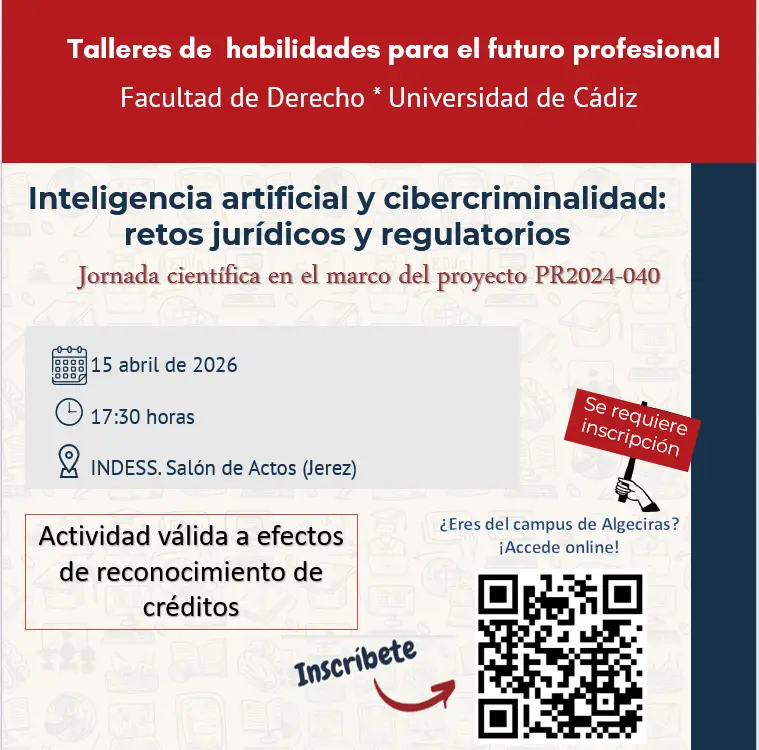
La inteligencia artificial ya no es futuro: es una herramienta clave en la prevención del delito.

Desde la detección de patrones en cibercriminalidad hasta el análisis predictivo en criminología, la IA está transformando la forma en que entendemos la seguridad. Pero no todo es potencial: también existen límites, riesgos y grandes retos jurídicos y éticos que no podemos ignorar.

¿Hasta dónde puede llegar la IA en la prevención del crimen?
¿Dónde están sus límites sin vulnerar derechos fundamentales?
¿Qué papel juegan el Derecho y la Criminología en este nuevo escenario?

Una jornada para analizar, debatir y cuestionar el impacto real de estas tecnologías en la seguridad y la justicia.

 15 de abril de 2026
 17:30 h
 INDESS, Jerez

Actividad válida para reconocimiento de créditos.
Inscripción necesaria.